Industry
Financing for rail & transit equipment manufacturers
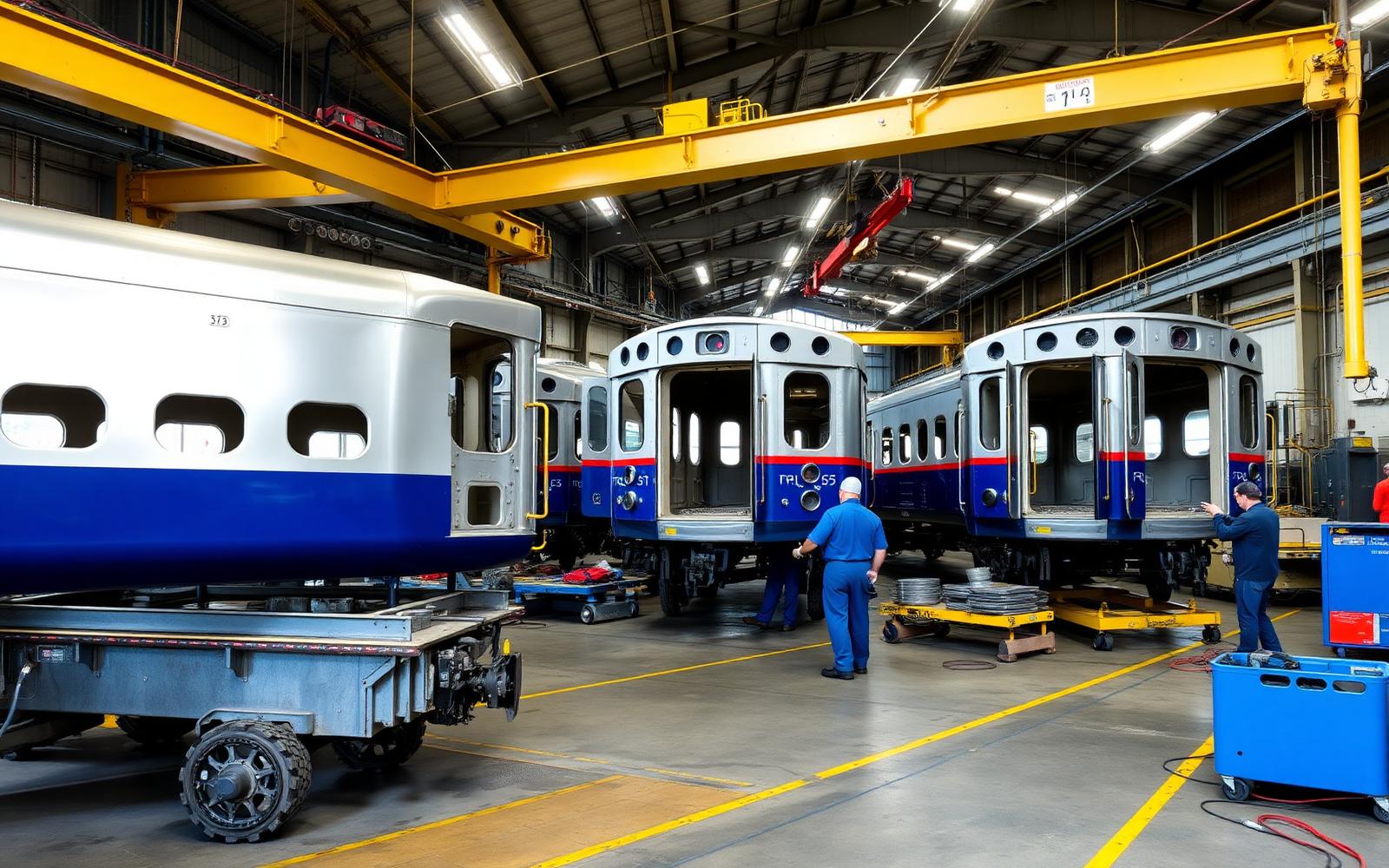
Rail car builders and transit component suppliers work under multi-year transit-authority contracts with Buy America compliance, FRA and APTA requirements, and payment cycles that lag far behind material and labor outlay. We connect them with lenders who understand this contract structure.
You're building rail cars or transit components against a multi-year contract awarded by a transit authority, with Buy America content requirements, FRA or APTA specs to meet, and a payment schedule tied to delivery and acceptance milestones that can run months apart.
That structure is great for backlog visibility and terrible for cash flow. Steel, propulsion components, and specialized subassemblies have to be bought and built well before a transit authority signs off on delivery and releases payment, and Buy America sourcing requirements often mean paying a premium for domestic content.
We work with lenders who understand transit authority contracts, FRA/APTA compliance timelines, and why a rail car mid-assembly is legitimate collateral even though its only real buyer is the contracting agency. That's the knowledge that makes funding a multi-year transit contract workable.
Want a written answer specific to your rail & transit equipment operation? Email a specialist — no pressure, no obligation, no fees to you.
Cash-flow challenges we solve
The specific spots where rail & transit equipment operators run out of runway — and where the right funding structure keeps you moving.
- Transit authority payment schedules tied to delivery and acceptance milestones, often 60–120 days apart
- Buy America domestic content requirements that raise material costs and sourcing lead times
- FRA and APTA compliance and testing cycles that delay revenue recognition
- Multi-year contract backlogs that require sustained working capital long before final payment
- Specialized component and propulsion system costs that must be funded far ahead of delivery
How funding works for rail & transit equipment
A typical referral path — tailored to how your cash cycle actually runs, not a generic small-business template.
You win the transit authority contract
A transit agency or rail operator awards a multi-year rail car build or component supply contract with defined delivery milestones.
We fund materials and production between milestones
A working capital line or asset-based facility against work-in-process and contract value funds Buy America-compliant materials, subassemblies, and labor.
You bill the milestone, we advance against it
Once a delivery or acceptance milestone is invoiced, factoring or ABL advances against that billing instead of waiting the full transit-authority payment cycle.
The transit authority pays, the line resets
Payment clears on the agency's schedule, reserves release, and your facility is ready to fund the next milestone or the next car in the contract.
Which program fits rail & transit equipment best?
A side-by-side view of the programs manufacturers in this space actually use — ranked by how often they're the right fit for rail & transit equipment operators. Your specific match depends on buyers, margins, and what you're trying to solve.
- Best for
- Adding capacity — CNC, robotics, lines, tooling, vehicles
- Speed
- 3–10 business days
- Typical size
- $25K–$5M per asset
- Watch for
- Rate/term depend on asset age, condition, and useful life
Adds machinery, tooling, or vehicles for Rail & Transit Equipment operations without draining working capital.
See Equipment Financing details- Best for
- Established manufacturers with A/R, inventory, and equipment collateral
- Speed
- 3–6 weeks
- Typical size
- $1M–$50M+ revolver
- Watch for
- Requires monthly reporting and borrowing-base discipline
A scalable revolver against A/R, inventory, and equipment — usually a fit for larger Rail & Transit Equipment manufacturers with clean books.
See Asset-Based Lending (ABL) details- Best for
- Short-term gaps — payroll, materials, a specific catch-up
- Speed
- 2–7 business days
- Typical size
- $25K–$1M
- Watch for
- Shorter terms, higher effective cost — use with a clear payoff plan
Bridges short gaps in Rail & Transit Equipment operations — payroll, a materials buy, or a specific catch-up — without a long approval process.
See Working Capital details- Best for
- Shops with creditworthy B2B / gov buyers on net-30/60/90
- Speed
- 7–14 days to onboard, 24–48 hrs per invoice after
- Typical size
- $25K–$10M+ per month
- Watch for
- Your customers' credit matters more than yours
Sometimes used. Converts open invoices into cash fast — a natural fit for Rail & Transit Equipment shops selling to slow-paying commercial or government buyers.
See Invoice Factoring details- Best for
- Funded POs from creditworthy buyers when you can't self-fund materials
- Speed
- 1–3 weeks
- Typical size
- $100K–$25M per PO
- Watch for
- Gross margins usually need to clear ~20–25% to pencil
Sometimes used. Funds materials and production on real, awarded POs so Rail & Transit Equipment manufacturers can accept orders bigger than their cash on hand.
See Purchase Order Financing details- Best for
- Real estate, acquisitions, refis, long-horizon growth capital
- Speed
- 45–120 days
- Typical size
- $150K–$5M+
- Watch for
- Longest timeline and most documentation of any program
Sometimes used. Long-horizon capital for Rail & Transit Equipment real estate, acquisitions, refis, or expansion — the slowest path, but usually the cheapest.
See SBA & Term Loans detailsSpeeds and sizes are typical ranges, not offers. Actual terms depend on underwriting and the funding partner. We are an independent referral service, not a bank, lender, or investor — nothing here is a commitment to fund.
Rail & Transit Equipment financing — FAQs
Yes. Asset-based lending and working capital facilities can advance against work-in-process value and contract billings so production isn't paused while waiting on transit-authority acceptance and payment.
Yes. Lenders experienced with transit and government-adjacent manufacturing understand Buy America domestic content rules and how they affect sourcing costs and timelines on transit-authority contracts.
Once a delivery or acceptance milestone is invoiced and approved, factoring can advance a percentage of that billing within days rather than waiting the typical 60–120 day transit-authority payment cycle.
Yes. Equipment financing can cover testing equipment, tooling, and production line investment needed to meet FRA and APTA specifications, structured over the equipment's useful life.
ABL facilities typically advance against work-in-process, contract billings, raw material and component inventory, and equipment, sized to what's verifiably under contract and on the production floor.
Subcontractors and component suppliers qualify. Underwriting reviews the flow-down contract terms and the prime's or transit authority's payment history to size an appropriate facility.
ABL and working capital facilities typically take 3–5 weeks given contract and collateral review. Factoring against an approved milestone invoice can fund in 24–48 hours once the account is established.
Related industries we fund
Metal Fabrication
Funding for job shops, structural fab, precision machining, and CNC operations.
Industrial Machinery & Equipment
Working capital and equipment financing for OEM machine builders, integrators, and heavy equipment manufacturers.
Electronics & Electrical Manufacturing
Capital for EMS providers, PCB assembly, and electrical component makers.
Rail & Transit Equipment manufacturing hubs we serve
Jump into a local page for buyer context, eligibility, and program mechanics for rail & transit equipment shops.
Keep reading
Hub resources that explain how state funding guides works for US manufacturers.
Related guides
Comparisons
Funding Requirements Checklist for US manufacturers
See exactly what underwriters actually look at — for factoring, PO financing, equipment, working capital, ABL, and SBA — before you fill out a single application.
- What documents you need for each program
- Typical time-to-fund by program
- Common disqualifiers worth knowing up front
- How Manufactor Finance is compensated — $0 fees to you
Talk to a funding specialist
Questions before you apply? A specialist can walk through this checklist with you, no pressure and no obligation.
Ready to keep production moving?
Start with a quick app or a phone call. We'll tell you exactly what the right program requires. At no charge.
Apply. Fund. Deliver. No obligation.
AI-assistedDepending on live availability, calls may be answered by Mary, our AI Assistant, who takes a message and books a callback. Or email us instead.